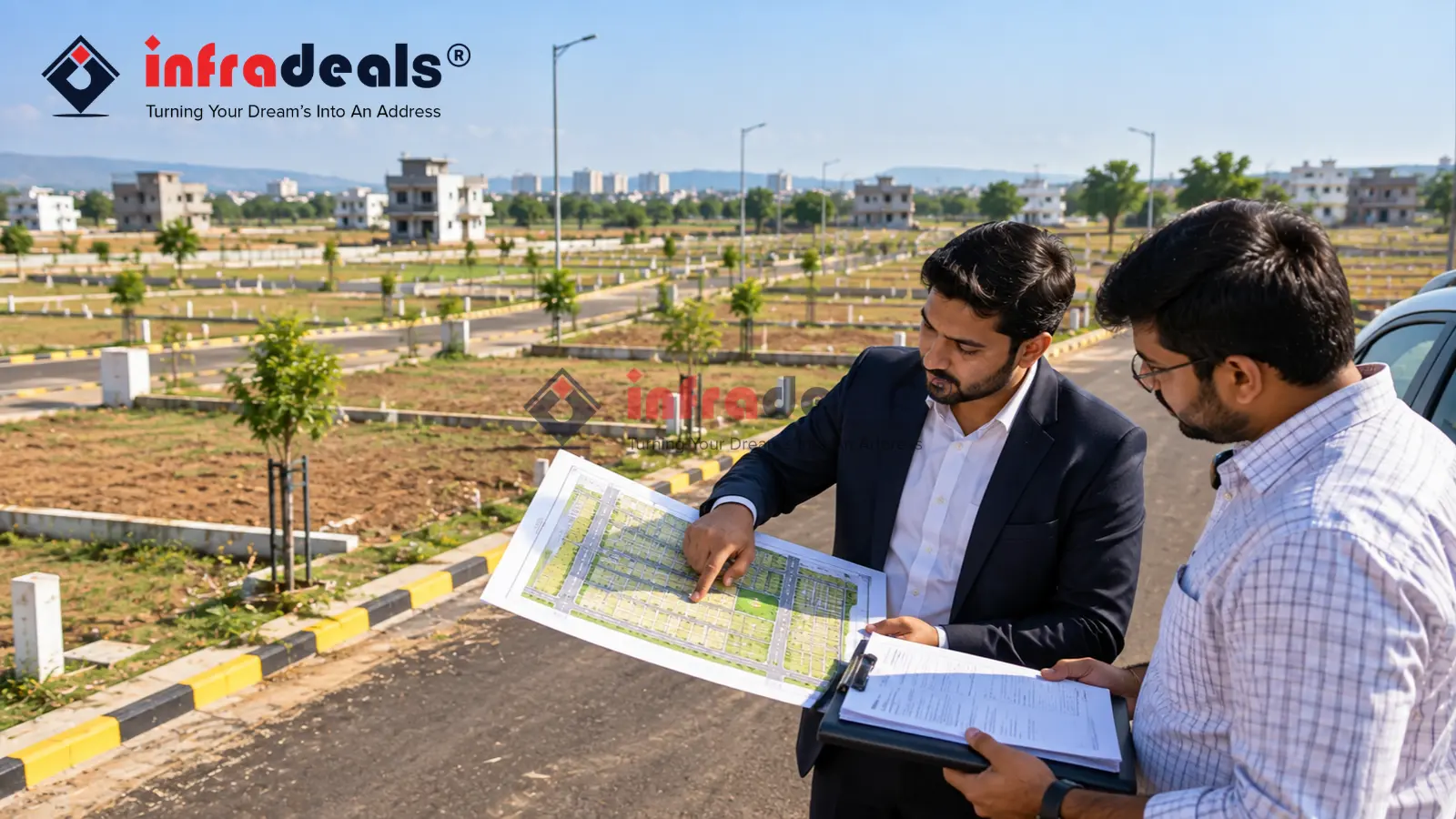
Buying a plot is a major financial decision. Before you pay a booking amount for a property, you should verify who owns the land, whether the intended use is permitted, whether the layout has the required approvals and whether the documents match the plot being offered. If you are researching how to verify a plot before buying in Amravati, use the following checklist as a starting point—not as a substitute for a qualified property lawyer’s review.
Amravati buyers may compare plotted layouts in established neighbourhoods and developing corridors, but every property has its own documentation and approval requirements. Do not assume that a plot is legally clear simply because it is advertised as “approved,” “NA” or “ready to build.” Ask for supporting records and verify them independently.
Why Plot Verification Matters Before You Buy
A site visit can help you assess the road, surroundings and physical boundaries, but it cannot establish legal ownership on its own. Similarly, a brochure or receipt does not prove that all required permissions are in place. Proper checks can help you identify title concerns, land-use restrictions, access issues, undisclosed charges or inconsistencies before committing money.
15 Checks to Complete Before Buying a Plot
1. Verify the Seller’s Identity and Authority
Check the seller’s identity and confirm that the person signing the agreement has the
legal authority to sell. If someone is acting through a power of attorney, have a lawyer
verify that document and its scope. For a company or partnership, confirm who is
authorised to execute the transaction.
2. Review the Title Deed and Ownership History
Ask for the relevant title documents and have a property lawyer review the ownership
chain for the appropriate period. The aim is to understand how the land was transferred,
whether the seller has the right to sell it and whether any gaps or competing claims
need further investigation.
3. Check the Applicable Land Records
Depending on the land and record system, review the applicable 7/12 extract, Property
Card, mutation entries and other revenue records. These records are important checks,
but they should not be treated as a replacement for title verification. Names, survey or
gat numbers, area and other details should be consistent across documents.
4. Confirm the Survey Number and Plot Identity
Match the survey/gat number, plot number, layout plan, dimensions and location across
the documents. Make sure the plot shown to you on site is the same plot described in the
agreement and approved plan. Resolve discrepancies before proceeding.
5. Verify NA Status and Permitted Land Use
If the plot is being sold for residential construction, verify the applicable
non-agricultural (NA) status or other land-use permission, as relevant to that property.
Do not rely on verbal assurances. The exact permissions required depend on the land
classification, location and applicable planning rules.
6. Review the Approved Layout and Development Permissions
For a plotted development, ask for the sanctioned layout and relevant development
permissions from the competent authority. Confirm that the specific plot appears in the
approved plan and that roads, open spaces and amenity areas are represented accurately.
Approval requirements can vary by location and project.
7. Check for Encumbrances, Loans and Disputes
Ask whether the property is mortgaged, subject to a claim, involved in litigation or
affected by any other liability. A lawyer can advise on appropriate searches and
documents to review. If a loan or charge exists, understand how it will be cleared and
documented before registration.
8. Check MahaRERA Registration or Applicable Exemption
Where the project falls within the scope of the Real Estate (Regulation and Development)
Act and applicable rules, verify the project’s MahaRERA registration details and compare
them with the project being marketed. Not every individual plot transaction or
development is automatically subject to the same registration requirements;
applicability and exemptions depend on the facts and law. Check the official MahaRERA
portal or obtain legal advice where uncertain.
9. Inspect the Plot and Its Boundaries
Visit the site in person. Check access, boundary markers, surrounding occupation,
drainage, slope and any visible encroachment. For a boundary or measurement concern,
consider a qualified surveyor and compare the site with the approved plan and official
records.
10. Confirm Legal Road Access
Ensure the plot has lawful access from a public road or a properly documented access
route. A visible track or a road shown in a marketing image does not by itself prove
legal access. Check the approved layout and relevant records.
11. Verify Water, Electricity and Drainage Claims
Ask which utilities are already available, which are planned and who is responsible for
providing them. Request written project specifications and applicable connection or
development charges. Distinguish completed infrastructure from proposed future work.
12. Understand Open Spaces and Common Areas
Check how internal roads, open spaces, amenities and common areas are shown in the
sanctioned plan and transaction documents. Clarify what is included in the purchase and
whether any maintenance or association arrangements will apply.
13. Ask for a Complete Cost Breakdown
Get a written estimate of the total cost, including the plot price, stamp duty,
registration, taxes where applicable, development charges, utility charges, maintenance
deposits and other contractual fees. Compare like-for-like totals rather than just the
advertised base price.
14. Read the Agreement Before Paying
Read the booking form, allotment letter and agreement carefully. Check the exact plot
details, payment milestones, cancellation terms, possession or handover conditions,
refund provisions and responsibility for outstanding charges. Do not sign blank
documents or rely on verbal promises that are absent from the written agreement.
15. Verify Every Important Claim Independently
Keep copies of the documents reviewed and record any promises about roads, utilities,
amenities or completion dates in writing. Verify material claims with the relevant
authority or a qualified professional. If a seller pressures you to pay immediately
before allowing checks, pause the transaction.
How to Verify Plot Documents in Maharashtra
Start by collecting the property’s identifying details, such as the survey/gat number, plot number, village or locality, and the seller’s title documents. Review applicable land records through official Maharashtra land-record services, then have a qualified property lawyer examine title, permissions, encumbrances and the proposed agreement. For project registration questions, use the official MahaRERA website.
Useful official starting points include the Amravati District Administration land-records pageAmravati District Administration land-records page and the MahaRERA websiteMahaRERA website. Availability of records online does not remove the need to verify the underlying documents and transaction.
Red Flags to Watch for Before Paying a Token Amount
- The seller refuses to share ownership or approval documents.
- The plot number, survey number, area or seller name differs across records.
- Residential use is promised but the relevant land-use permissions are unclear.
- The advertised road or amenities do not match the approved layout or site conditions.
- There is pressure to pay immediately or sign incomplete documents.
- The total price and additional charges are not provided in writing.
- A claim of RERA approval is made but the registration details cannot be verified where registration is applicable.
Questions to Ask a Property Dealer in Amravati
- Which documents and approvals can I review before booking?
- Does the exact plot appear in the sanctioned layout?
- What infrastructure is completed and what is still proposed?
- What is the full cost, including registration and other charges?
- Are there any known encumbrances, access issues or pending permissions?
- Can I take the documents to my independent lawyer before paying?
If you are comparing available options, start with Infradeals’ residential plots in Amravati, browse Amravati plots for sale, or learn more about working with a property dealer in Amravati. You can also explore the best property broker in Amravati page to understand the services available to buyers.
How Infradeals Can Help You Explore Plot Options
A local property team can help you understand the available options, compare locations and coordinate the information needed for a property visit. Before making a purchase, buyers should still independently verify legal documents and approvals with the relevant authorities and a qualified lawyer. Infradeals can be a starting point for exploring residential plots in Amravati and discussing your requirements through its contact page.
Conclusion
Before buying a plot in Amravati, check the seller’s authority, title, land records, land use, layout approvals, encumbrances, access, infrastructure and agreement terms. The correct checks depend on the property and its location, so do not treat any single document as complete proof that a plot is safe to buy. Take a site visit, get independent legal review and make payments only after you understand the documents and full cost.